What Happens When You Meditate Inside Virtual Reality
When most people imagine meditating, they picture something pretty familiar:
- A cushion.
- Closed eyes.
- Maybe a bell app on their phone if they’re feeling fancy.
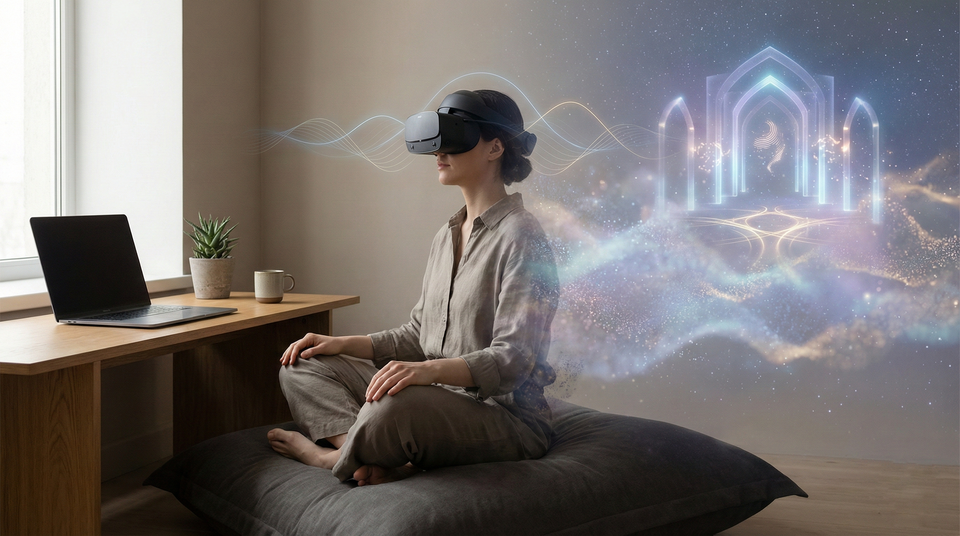
Very few people picture themselves with a VR headset strapped to their face.
That makes sense. On the surface, VR looks like the exact opposite of what meditation is supposed to be about. One is marketed as escapism and entertainment. The other is framed as coming back to yourself and waking up from illusion.
And yet, I keep coming back to this simple, slightly uncomfortable observation:
Your brain does not care where its sensory data comes from.
If the signals are convincing enough, it will treat virtual experiences as “real enough” to change how you feel, how you think, and how you behave in the world afterward.
In other words: VR is not just a toy. It’s one of the most underestimated tools we have for mental training – including meditation – when it’s used well.
VR is not my main way of meditating. I don’t think it should replace traditional practice. But I’ve seen enough – in research, in workshops, and in my own life – that I’m willing to argue: VR meditation is legitimate, and it’s worth trying.
The rest of this piece is my case for that.
VR is supposed to be a toy, right?
If you look at the top downloads on most headset storefronts, the story is pretty straightforward:
- Games.
- Fitness games (which are still games).
- Social hangouts, video apps, “experiences.”
The implicit conclusion is easy to absorb: VR is for distraction; meditation is for seriousness. Why on earth would you combine them?
That story made sense in 2017. It’s increasingly wrong now.
Over the past decade, researchers and practitioners have been quietly using VR and broader XR for things that have nothing to do with entertainment:
- Exposure therapy for PTSD.
- Perspective-shifting experiments that change implicit bias.
- Psychedelic-adjacent group experiences (like Issness-D) that some participants rate as on par with drug-induced transcendence.
- Performance training for athletes, surgeons, and pilots, where “mental reps” in VR measurably improve real-world outcomes.
None of that means “VR is enlightenment in a box.” It does mean the medium is more serious than most people give it credit for.
Rehearsing a wedding in a virtual opera house
A while back, my friend Nick asked me to officiate his wedding at the Marigny Opera House in New Orleans. If you’ve never officiated a wedding: it’s not a casual role. You’re carrying a huge emotional moment in a space that already has its own gravitas baked in.
I wanted to do it justice. So I did something slightly weird: I recreated a simple version of the Marigny Opera House in VR and practiced the ceremony in there.
It wasn’t a perfect 3D scan. Think of it more like a stylized stage. I stood in that virtual version of the venue and ran the ceremony over and over.
- I practiced the pacing.
- I practiced the pauses.
- I practiced eye contact—where I’d look at the couple versus the audience.
The Result
Fast-forward to the actual ceremony. After the first couple of sentences, something shifted. The whole thing dropped into a deep flow state that carried through the ceremony and even twenty minutes afterward.
The feedback was clear. The couple loved it, and multiple guests asked if I did this professionally. The most telling moment was with the bride’s dad—a very direct, intimidating guy. After the ceremony, he told me he couldn't believe it was my first time; the poise felt truly professional.
Did VR do all of that? Of course not. But rehearsing in a space that my nervous system recognized as “close enough” to the real venue changed how my body responded on the day. VR is a mental flight simulator.
Why VR feels “real enough” to change you
To understand why this works, it helps to zoom out from “cool gadgets” into how the brain actually handles reality.
1. Embodied Cognition
Your brain is not a detached thinking machine. It is constantly predicting and updating based on your body, your environment, and your actions. Change the body signals and environmental cues, and the brain updates its sense of “what’s happening” accordingly.
2. The Rubber Hand Illusion
In this classic experiment, a fake rubber hand is placed in front of a subject while their real hand is hidden. Both are stroked in synchrony. Eventually, the person feels like the rubber hand is theirs. If you threaten the rubber hand with a knife, their body shows genuine fear.
If that trickery works with a rubber hand, imagine what happens when we control the entire visual and auditory field.
3. The Proteus Effect
Research shows that who you appear to be in a virtual environment changes how you behave. This is the Proteus Effect: embodying a different avatar—taller, older, or even a different skin color—can shift behavior. In some studies, inhabiting an avatar with a different skin tone has temporarily reduced markers of implicit racial bias.
Translation: When you change the virtual body, you change the felt experience of being you.
Meditating in VR: What actually changes?
When you meditate inside VR, a few things happen that are hard to replicate in a living room:
Instant Context Shift
Instead of closing your eyes on your couch, you drop into a forest clearing or a floating temple. This breaks the association with your work environment and recruits more of your attention because it’s sensory-rich.
Spatial Anchors for Awareness
Meditation instructions often ask you to “feel your body as a field of sensations.” In VR, you can literally see and inhabit a subtle body model. Your mind gets more handles to attach to; you can’t just drift in abstraction as easily.
Intentional Sensory Control
In a well-designed VR environment, you can deliberately constrain the sensory field: no phone, no laptop, no dirty dishes. You can add specific cues—rhythmic pulses or spatialized sound—that support the practice.
The right question is: For whom, at what stage, and for what purpose?
The thousand paper cuts holding VR back
I need to be honest about the current state of the tech. If you’ve used a headset recently, you’ve likely dealt with:
- Clunky menus and confusing interfaces.
- Motion sickness or eye strain.
- Headsets that feel like a brick strapped to your face.
I call these the thousand paper cuts. Every extra second spent wrestling with menus or every nausea spike adds cognitive load. Enough load, and people bounce before they ever reach the interesting territory.
We should design VR and XR experiences to work with our biology, not against it.
The coming convergence: AI, XR, and inner work
Imagine cleaning up those paper cuts and adding AI. We are already seeing:
- Meditation environments that subtly change based on your real-time brain activity (EEG).
- Therapeutic XR scenes that help people reprocess trauma in a controlled way.
- Personalized mental gyms where you can rehearse high-stakes negotiations or presentations.
As development becomes easier, the bottleneck shifts from "can we build this?" to "what should we build that actually helps human beings?"
So… should you meditate in VR?
Here is my current, honest stance:
- It is not a replacement for traditional sitting.
- It is a legitimate supplement that can help people access deeper states more quickly.
- The UX friction is real. It will turn some people off.
- Be careful if you are prone to dissociation or use tech purely as escapism.
My recommendation: Treat VR/XR not as a toy, but as an experiment.
Pick one thing where your inner state matters—a talk, a tough conversation, or a creative sprint—and try using a headset as a dedicated “mental gym” for a week.
The brain doesn’t come with a “real world vs virtual world” toggle. It just gets signals and rewires based on what you repeatedly show it. The question isn’t whether VR is real enough; it’s whether we’ll use it well enough.
Member discussion